


The Corruption Candidates Protect: Why No One in D.C. Will Expose "RelayGate"
- M.Bradley Ray

- May 11
- 4 min read
Updated: May 12
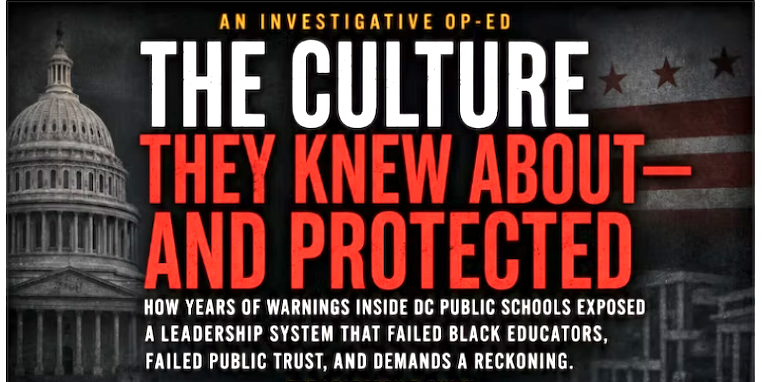
D.C. education crisis is not just failing schools, it's the culture of fear, silence, and political protection that allowed RelayGate to survive unchecked--at the expense of Black children

As the District of Columbia barrels toward what many are calling the most consequential election since the District of Columbia Home Rule Act of 1973, every major candidate is talking about education.
They debate absenteeism, public safety in schools, teacher retention, and budgets. Yet one subject remains politically radioactive: the entrenched corruption and glaring inequities that flourished during Mayor Muriel Bowser’s decade-long authoritarian rule over D.C. Public Schools (DCPS).
The Scandal No One Will Name
Most striking of all is the silence surrounding what critics have come to call “RelayGate.” Under the banner of Relay, corrupt schemes masquerading as education reform impacted thousands of Black elementary school students, most of them living in Wards 7 and 8.
A Principal Sounds the Alarm
In 2019, Boone Elementary principal Dr. Carolyn Jackson‑King tried to stop a disaster before it hit D.C. classrooms, warning DCPS that its new partnership with Relay Graduate School of Education (Relay) was nothing short of dangerous: a nationally notorious program built on what critics call racist, school‑to‑prison‑pipeline,“no‑excuses” discipline, rigid behavioral control, and the deliberate silencing of independent thought.
A year earlier, in 2018, she had traveled out of state to watch Relay in action and was stunned by the compliance‑obsessed, command‑and‑control culture she saw imposed on children. DCPS brass tried to dress it up, claiming they would simply strip out the racist parts and keep Relay’s “weekly data‑meeting” model, as if you can somehow surgically remove the racism from an institution designed to control Black children while still paying it millions to train your teachers.
Why would a school district serving majority Black children funnel D.C. tax dollars into an outfit whose entire business model has been condemned for criminalizing, surveilling, and dehumanizing Black bodies?
Whistleblowers Punished, Not Protected
In 2020, Boone’s Director of Strategy & Logistics, Marlon Ray, filed a formal whistleblower complaint detailing disparate treatment, procurement fraud, and conflicts of interest inside DCPS, all specifically connected to Relay. He and Jackson‑King met with their council member, who wrote the chancellor directly, and Ray personally notified Mayor Bowser, who told him she would speak with the chancellor; on its face, that kind of high‑level engagement should have triggered serious scrutiny.
Instead, from 2020 to 2021, DCPS fired both Jackson‑King and Ray—along with several principals who pushed back against Relay’s practices. By 2022–2023, staff who were aligned with them were targeted, retaliated against, and quietly erased through “reductions in force” or position eliminations.
The October Surprise
Then, in October 2025, the Instructional Superintendent overseeing Boone Elementary—who gave Dr. Jackson‑King her lowest evaluation and removed Ray’s name from the coveted Standing Ovation award—finally admitted to conflicts of interest, coercive educational practices, pay‑to‑play arrangements, and double‑dipping as an independent contractor with Relay, one of two DCPS Instructional Superintendents implicated in the scheme. Yet even with these stunning admissions, there has been no sustained investigation by major local media or by elected officials, who have so far treated this scandal as if it were just another routine personnel matter instead of a systemic betrayal of D.C. families, children, and taxpayers.
One outlet, The Washington Times, touched the controversy after the October surprise. Beyond that? Near-total silence.
Why RelayGate Remains Buried
That question may be more revealing than the scandal itself. The obvious answer is Fear, Power, and Silence has kept RelayGate buried.
The refusal of mayoral candidates, at-large council contenders, and even congressional hopefuls to directly confront RelayGate exposes the political ecosystem that now governs D.C. In a city dominated by one-party rule and tightly interconnected political, nonprofit, media, and education networks, challenging the mayor’s education apparatus risks professional exile. Consultants, advocacy groups, nonprofit executives, education contractors, and political operatives all feed from the same ecosystem of contracts, appointments, endorsements, and influence.
RelayGate threatens more than reputations. It threatens the carefully manufactured narrative that D.C. has been progressing under Bowser’s leadership.
For over a decade, City Hall has aggressively marketed D.C. as a national model for urban school reform. However, beneath the branding campaigns and positive press releases, there is a troubling reality: Black elementary students in schools located in impoverished wards face practices that are not implemented in wealthier schools west of the Anacostia River.
Critics argue that RelayGate exposed a dual education system operating inside the nation’s capital — one for politically connected and affluent families, and another for Black children in historically marginalized neighborhoods. That is not reform. That is systemic inequity repackaged as innovation.
The Deeper Scandal: Silence
The deeper scandal is not merely what happened inside DCPS. The deeper scandal is the collective decision not to investigate it.
Where are the emergency council hearings? Where are the independent audits? Where are the demands from candidates claiming they will restore trust with more "accountability and transparency?" Why hasn't any major local television station aggressively investigated the allegations that have now been proven true? Why do numerous officials who fervently discuss "equity" suddenly fall silent when accusations involve powerful institutions connected to the Bowser administration?
Silence, in politics, is rarely accidental.
Sometimes silence is protection.
Sometimes silence is complicity.
And sometimes silence is a calculated strategy to preserve power long enough for the public to forget the questions they were never allowed to ask.
If D.C.’s candidates truly believe this election is historic, then they must prove it by confronting the corruption they deliberately refuse to expose.


Comments